Revenue sharing billing: the guide to calculating and paying partners
You negotiate a revenue share once. You calculate it, check it and pay it every month.
A telecom operator that bundles a video service into its plans, an energy supplier that sells an installer's services, a software vendor that sells through resellers, a franchise network: they all share revenue with partners. The principle fits in one sentence of the contract. The reality is thousands of lines to calculate every month, with different rules for each partner, refunds, unpaid invoices and disputes.
This guide explains what revenue sharing billing is, the most common revenue share models, how to calculate and pay each partner's share, what to check, what changes in accounting, and how to automate it all without spreadsheets.
What is revenue sharing?
Revenue sharing is an agreement under which a company pays one or more partners a share of the revenue generated by a sale, a subscription or usage, according to rules set in the contract: a percentage, a fixed amount, tiers or a minimum guarantee.
Revenue sharing differs from three related ideas:
- A commission rewards an intermediary for a sale (a referrer, a sales agent). It is often one-off. A revenue share lasts as long as the customer pays.
- A royalty pays for the use of a right: a brand, a patent, content. It can take the form of a revenue share, but it is tied to ownership.
- Billing on behalf of third parties applies to marketplaces, which collect payment for sellers and then pay them out. Our guide to marketplace billing covers it.
In every case the hard part is the same: what the partner is owed depends on what the end customer actually bought, used and paid. Revenue sharing is first a billing problem, not a contract problem.
Why revenue sharing is spreading
Companies increasingly team up to sell bundles, expand their catalog without building everything themselves and reach new customers through partners. Every partnership creates a revenue stream to share.
These are B2B2X models: a company sells to a partner who serves businesses or consumers, or the other way round. The most common cases:
- Bundles: a mobile plan that includes a music service, an energy offer with a maintenance service, a software subscription with a third-party module.
- Indirect sales: resellers, integrators, distributors, white labels.
- Platforms and ecosystems: app stores, service marketplaces, partner catalogs.
- Networks: franchises, agency networks, cooperatives.
- Shared infrastructure: EV charging networks, mobile virtual network operators (MVNOs), shared towers.
Six revenue share models
The most common models are a fixed percentage, a fixed amount per unit, tiers, a minimum guarantee, a share after costs and hybrid models. One partner can combine several rules.
| Model | How it works | Example | Watch out for |
|---|---|---|---|
| Fixed percentage | The partner gets a percentage of revenue | 30% of the add-on price | Which base: billed, collected, net of tax? |
| Fixed amount per unit | An amount per subscriber, sale or usage unit | $2 per active subscriber per month | Define "active" precisely |
| Tiers | The percentage changes with volume | 20% up to 1,000 subscribers, 25% above | Whole-volume or progressive tiers |
| Minimum guarantee | The partner gets at least a set amount | 70% of revenue, with a monthly minimum | True-up at period end |
| After costs | The share applies to margin | 50% of margin after payment fees | List of deductible costs |
| Hybrid | Several rules combined | Fixed per subscriber + percentage of usage | Order in which rules apply |
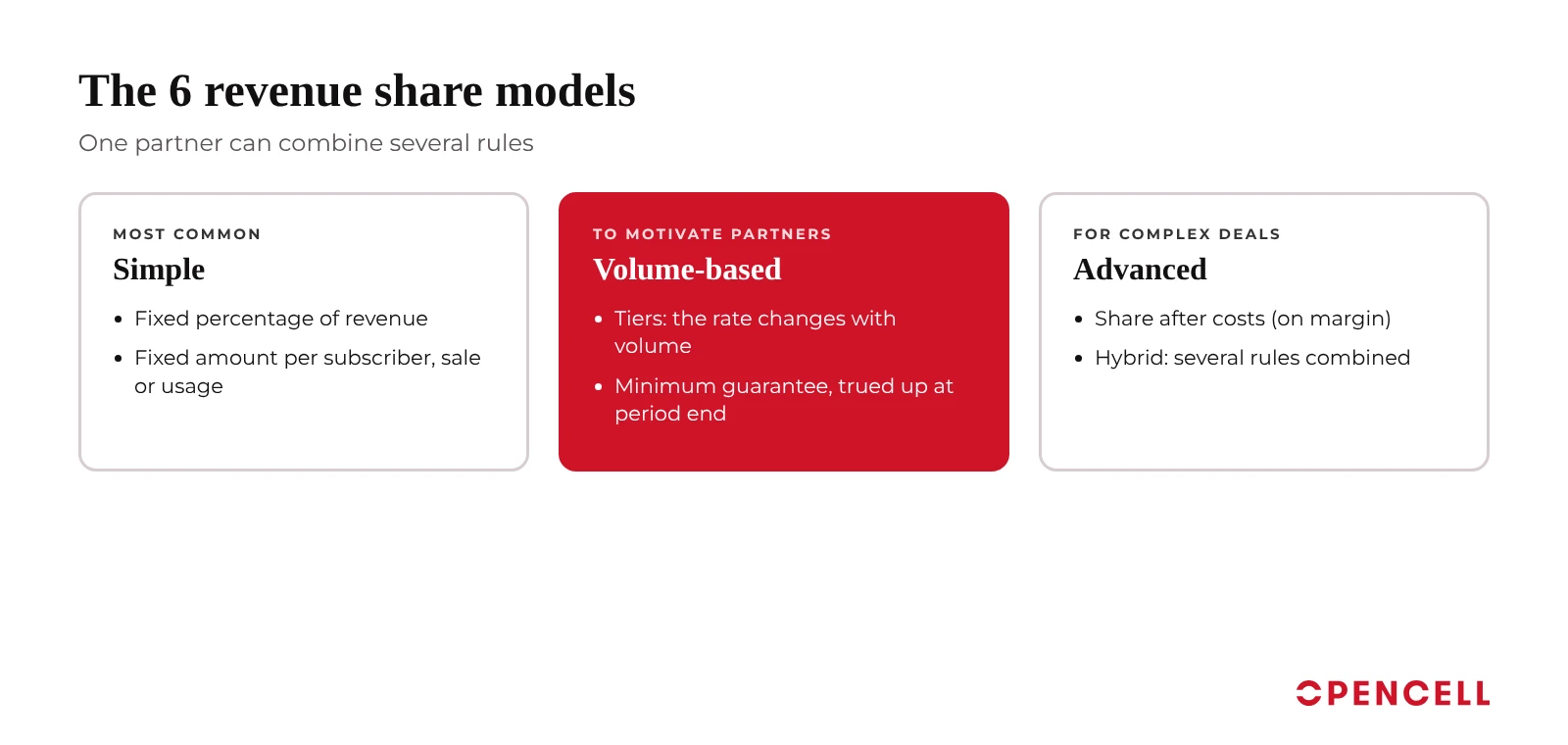
The calculation base is the most important clause, and often the vaguest. "30% of revenue" can mean 30% of billed, of collected, net of tax, after discounts, after refunds. Each reading gives a different amount. A well-written contract spells out the base, the period, and how discounts, credit notes and unpaid invoices are handled.
How to calculate each partner's share
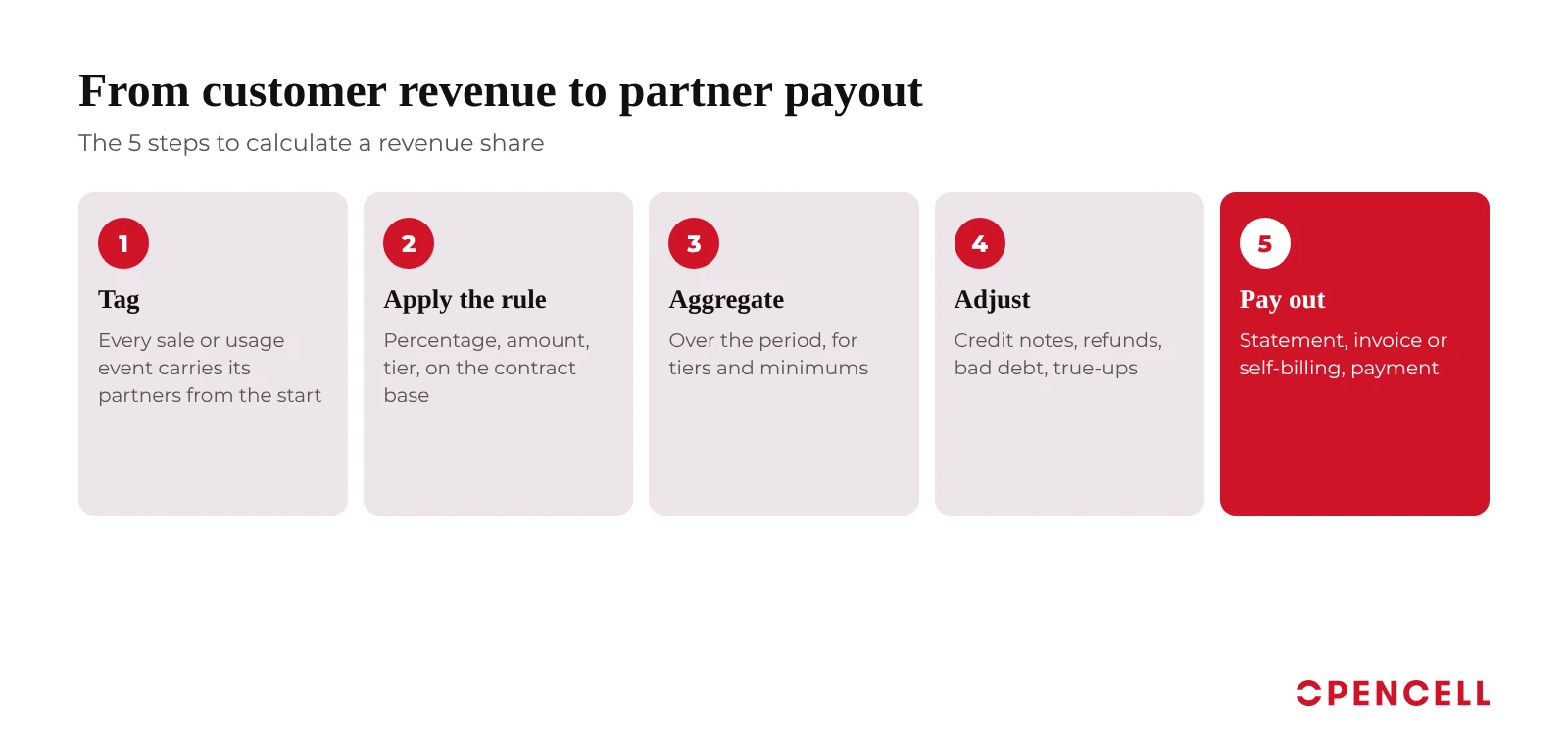
The calculation always follows the same chain: identify what belongs to each partner in each sale or usage event, apply the contract rule, aggregate over the period, then adjust for refunds, unpaid invoices and true-ups.
- Tag every revenue line with its partner. Each invoice line, subscription or usage event must carry the ID of the partner or partners involved. Without tagging at the point of sale, the calculation becomes an investigation.
- Apply the rule. Percentage, amount per unit, tier: the rule applies to the base defined in the contract.
- Aggregate over the period. Tiers and minimum guarantees are calculated on cumulative volume or amount, not line by line.
- Adjust. Credit notes, refunds and unpaid invoices reduce the partner's share if the contract says so. True-ups from previous periods are added.
- Produce the statement. The partner receives the detail behind the amount: volumes, bases, rates, adjustments.
A simple example. An operator includes a video service in a $6-per-month add-on and pays the content provider 50% of the add-on price, with a $2.50 minimum per subscriber. In January, 10,000 subscribers have the add-on, including 200 on a 50% discount for three months. The 9,800 full-price subscribers generate $3 each for the provider. The 200 discounted subscribers generate $1.50, raised to the $2.50 minimum. The provider's share is $29,400 + $500 = $29,900 for the month, before adjustments.
Paying out: statements, self-billing and payment
Once the share is calculated, it has to be paid: either the partner invoices the company based on a statement, or the company issues the invoice on the partner's behalf (self-billing), then payment follows.
Two set-ups coexist:
- The partner invoices. The company sends a monthly statement, the partner issues an invoice, the company checks and pays it. Simple on paper, this creates back-and-forth and delays.
- Self-billing. The company issues the invoice in the partner's name, under a written agreement. The invoice matches the calculation exactly, which reduces differences and speeds up payment. The partner can still dispute it.
E-invoicing mandates increasingly cover these business-to-business flows too. In France, for example, they go through certified platforms under the official timeline. One more reason to produce settlement invoices from the system that calculates the share, rather than from a spreadsheet.
Payment can be net (the company offsets what the partner owes it against what it owes the partner) or gross (each flow paid separately). Netting simplifies cash management but requires a very clear statement.
Frequency is also negotiated: monthly for high-volume partners, quarterly for others, with a minimum threshold below which the amount rolls over. The delay between period end and payment matters to partners: the more automated the calculation, the shorter it can be. A partner portal where each partner sees its volumes, statements and invoices cuts down requests to finance.
What to check
Reliable revenue sharing rests on four controls: completeness of tagged sales, accuracy of the rules applied, reconciliation with collections and traceability of every amount back to the contract.
| Control | The question | What happens without it |
|---|---|---|
| Completeness | Are all the partner's sales tagged? | The partner is underpaid, then disputes |
| Accuracy | Right rule, right contract version, right tier? | Silent overpayment or underpayment |
| Reconciliation | Does the payout match what was billed and collected? | Paying out on revenue never collected |
| Traceability | Can every amount be justified line by line? | Long disputes, painful audits |
Revenue sharing is also a classic source of revenue leakage: overpayments from a misapplied rule, payouts on customers who never paid, minimum guarantees forgotten at contract end. Our guide to revenue leakage covers these mechanisms.
What changes in accounting
In accounting, the key question is whether the company acts as principal or agent. Under IFRS 15 (and ASC 606 in the US), a principal recognizes gross revenue and records the partner's share as a cost; an agent recognizes only its commission, as net revenue.
IFRS 15 asks who controls the good or service before it is transferred to the customer. Typical indicators: who is responsible for fulfilling the promise to the customer, who bears inventory risk, who sets the price. An operator selling a plan that includes a third-party service under its own responsibility is often principal; a marketplace connecting buyers and sellers is often agent. Analyze each contract with your auditors.
Practical consequences for the billing system:
- Separate the two shares from the customer invoice onward, to feed revenue and partner costs or payables correctly.
- Accrue the partners' share every month, even if payouts are quarterly.
- Handle true-ups (tiers, minimum guarantees) in the right accounting period.
Our guide to IFRS 15 revenue recognition explains these principles in more detail.
Revenue sharing by industry
Each industry has its own forms of revenue sharing, but they all rely on the same mechanics: tag the usage or sale to the right partner, apply its rule, then pay out.
- Telecom. Operators share revenue from services bundled into their plans (video, music, news, gaming), from third-party services charged to the phone bill, and from wholesale deals with MVNOs. Volumes are high and usage is rated event by event. See our guide to telecom billing.
- Energy. Suppliers sell partner services (installation, maintenance, retrofits), and charging networks split revenue between charge point operators, mobility service providers and site hosts. See our guide to EV charging billing.
- Software and cloud. Vendors pay a share of the subscription to resellers and integrators, or to the vendor of an embedded module. Platforms pay a share of usage to catalog providers.
- Mobility. Mobility services split revenue between transport operators, transit authorities and booking or payment platforms.
- Services and franchises. Networks share a percentage of each location's revenue, often with fixed fees and marketing contributions.
Eight common mistakes
Most revenue sharing problems come from vague rules, late tagging of sales to partners and calculations done outside the billing system.
- A vague calculation base in the contract (billed or collected, before or after discounts).
- Tagging partners after the fact, instead of at the point of sale.
- Hard-coded rules in a spreadsheet or script that nobody can change.
- Ignoring contract versions: a new rate applied retroactively, or not at all.
- Forgetting credit notes and unpaid invoices in the partner share.
- Tiers calculated at the wrong level (line by line instead of cumulative).
- An unreadable statement that forces the partner to redo the math.
- No reconciliation between payouts, billing and accounting.
Automating revenue sharing: 10 criteria
A revenue sharing platform must tag every revenue line with its partners at the point of sale, apply configurable rules, calculate at high volume, produce statements and settlement invoices, and feed accounting.
- Tagging at the source: each offer, subscription or usage event carries its partners.
- Configurable rules: percentages, fixed amounts, tiers, minimums, after-cost shares, combinable.
- Contract versions: effective dates, history, true-ups.
- Volume: millions of usage events rated and shared each cycle.
- Automatic adjustments: credit notes, refunds, unpaid invoices, cancellations.
- Statements and self-billing: clear documents, compliant invoices, e-invoicing connections.
- Multi-currency and multi-entity for international partners.
- Accounting: revenue, partner cost and payable entries, accruals.
- Traceability: every amount traceable to the sales line and the contract rule.
- Openness: APIs to expose data to partners (portal, exports).
The deciding point: revenue sharing should live inside the billing system, not next to it. That is where sales, usage, discounts and credit notes live. A separate tool has to copy that data, and every copy is a chance for a mismatch.
How Opencell can help
Opencell handles revenue sharing at the heart of billing: partners are carried by offers and customer hierarchies, payouts are calculated in the same cycle as customer invoices, and every amount stays traceable.
- B2B2X hierarchies: customers, partners, distributors and sub-accounts modeled on one platform.
- Automated commissions and payouts between stakeholders, with configurable rules (percentages, amounts, tiers).
- Real-time usage rating, to share revenue from consumption as well as subscriptions.
- More than 200 APIs to feed accounting, payments and partner portals.
- Enterprise scale: €14 billion in revenue managed, around fifty customers including Orange, Engie, Eir and Fnac Darty, and go-live in 3 months on average.
Frequently asked questions about revenue sharing billing
What is revenue sharing billing?
It is the process of calculating, documenting and paying the share of revenue owed to partners under revenue sharing agreements, based on what end customers actually bought, used and paid.
What is the difference between revenue sharing and a commission?
A commission usually rewards a sale, often once. A revenue share lasts as long as the customer pays: the partner receives its share every period on the subscriptions and usage it helped generate.
How do you calculate a revenue share?
Tag each revenue line with its partners, apply the contract rule to the agreed base (billed or collected, net of tax, after discounts), aggregate over the period for tiers and minimums, then adjust for credit notes, refunds and unpaid invoices.
Should revenue share be based on billed or collected revenue?
The contract decides. Billed revenue is simpler and faster; collected revenue protects the company against non-payment. Many contracts calculate on billed revenue and then adjust for confirmed bad debt.
What is self-billing in revenue sharing?
The company issues the settlement invoice in the partner's name, under a written agreement. The invoice matches the calculation exactly, which reduces differences and speeds up payment.
How is revenue sharing treated under IFRS 15?
It depends on your role. As principal, you recognize gross revenue and record the partner's share as a cost; as agent, you recognize only your share as net revenue. Analyze each contract with your auditors.
Do you need dedicated revenue sharing software?
Beyond a few partners with simple rules, yes. The most effective approach is to calculate the share inside the billing system, where sales, usage, discounts and credit notes live, rather than in a separate tool fed by exports.
The contract sets the rule. The billing system builds the trust.
Key takeaways:
- revenue sharing is first a billing problem: it depends on what customers bought, used and paid,
- the calculation base matters more than the rate: billed or collected, discounts, credits, bad debt,
- tag every revenue line with its partners at the point of sale,
- give partners readable statements, and consider self-billing,
- calculate the share inside the billing system, not in a spreadsheet next to it.
Go further with Opencell
Opencell is an agile monetization platform that automates quote-to-cash, from quote to cash collection, for subscription and usage-based services. It manages B2B2X customer hierarchies, commissions and automated payouts between stakeholders. Its core is open source, it connects to your ecosystem through more than 200 APIs, deploys as sovereign SaaS, in the cloud or on premises, and goes live in 3 months on average. It manages €14 billion in revenue for around fifty customers, including Orange, Engie, Eir and Fnac Darty.
Need to automate partner revenue sharing?