
Mobility billing: the guide for operators, transit authorities and MaaS
In mobility, travelers no longer buy a ticket. They use a service, and the bill has to follow every trip.
For a long time, paying for mobility meant buying a ticket or a pass. Today the same traveler takes a bus, a shared bike, a car-sharing vehicle, parks in a garage and charges an electric vehicle, often through a single app. Behind that simplicity, every trip has to be counted, rated, billed, collected and then shared between several operators.
This guide explains what mobility billing covers, the pricing models in use, the shift from tickets to account-based travel, what Mobility as a Service (MaaS) changes, how revenue is shared between players, and how to choose a platform that can keep up.
What is mobility billing?
Mobility billing covers every step that turns the use of a transport or mobility service into a collected invoice: pricing, counting trips or durations, applying passes and discounts, invoicing, payment, collections and payouts to partners.
It involves very different players:
- Transit authorities, which define the service and fares in their area.
- Public transport operators (bus, tram, metro, regional rail, on-demand transport).
- Shared mobility operators: bike and scooter sharing, car sharing, mopeds, ride sharing.
- Parking: garages, on-street, park-and-ride.
- Vehicle services: EV charging, leasing, insurance, financing.
- MaaS platforms, which bundle several of these services into one app.
They share one shift: from selling tickets (a ticket, a booklet, a pass) to billing for services used, with rules that depend on the traveler's profile, time of day, duration, distance and combinations of modes.
Why mobility billing is changing
Three forces are reshaping billing: more modes of transport, travelers who want one simple journey paid once, and regulation that opens up ticket sales to multimodal platforms.
In France, for example, the 2019 mobility orientation law set a framework for multimodal digital services and a principle of opening ticket sales systems to MaaS platforms, under conditions and by contract. Similar initiatives exist across Europe.
For operators, that means new needs:
- Usage-based billing: per minute, per mile or kilometer, per trip, per charging session.
- Passes plus usage: a monthly plan that includes minutes, with overage.
- Fare capping: never charge more than the price of a pass over a period.
- Profiles: concession fares, students, seniors, businesses, with eligibility proof and validity dates.
- Revenue sharing between the authority, operators and the sales platform.
Mobility pricing models
Mobility pricing ranges from single tickets to passes, through usage-based pricing, bundles with overage, fare capping and profile-based fares. Most offers combine several models.
| Model | How it works | Example | What billing must handle |
|---|---|---|---|
| Single ticket | One price per trip | Bus ticket | Validation, refunds |
| Pass | Fixed price per period | Monthly pass | Proration, renewal, suspension |
| Usage | Price per minute, distance, session | Bike per minute, charging per kWh | Event collection, rating |
| Bundle and overage | Included allowance, then unit price | 60 minutes included, then a per-minute rate | Tracking, rollover, alerts |
| Fare capping | Charges stop at a cap | Never more than a day pass | Rolling calculation over the period |
| Profile-based fare | Different price by situation | Concession, student | Entitlements, proof, effective dates |
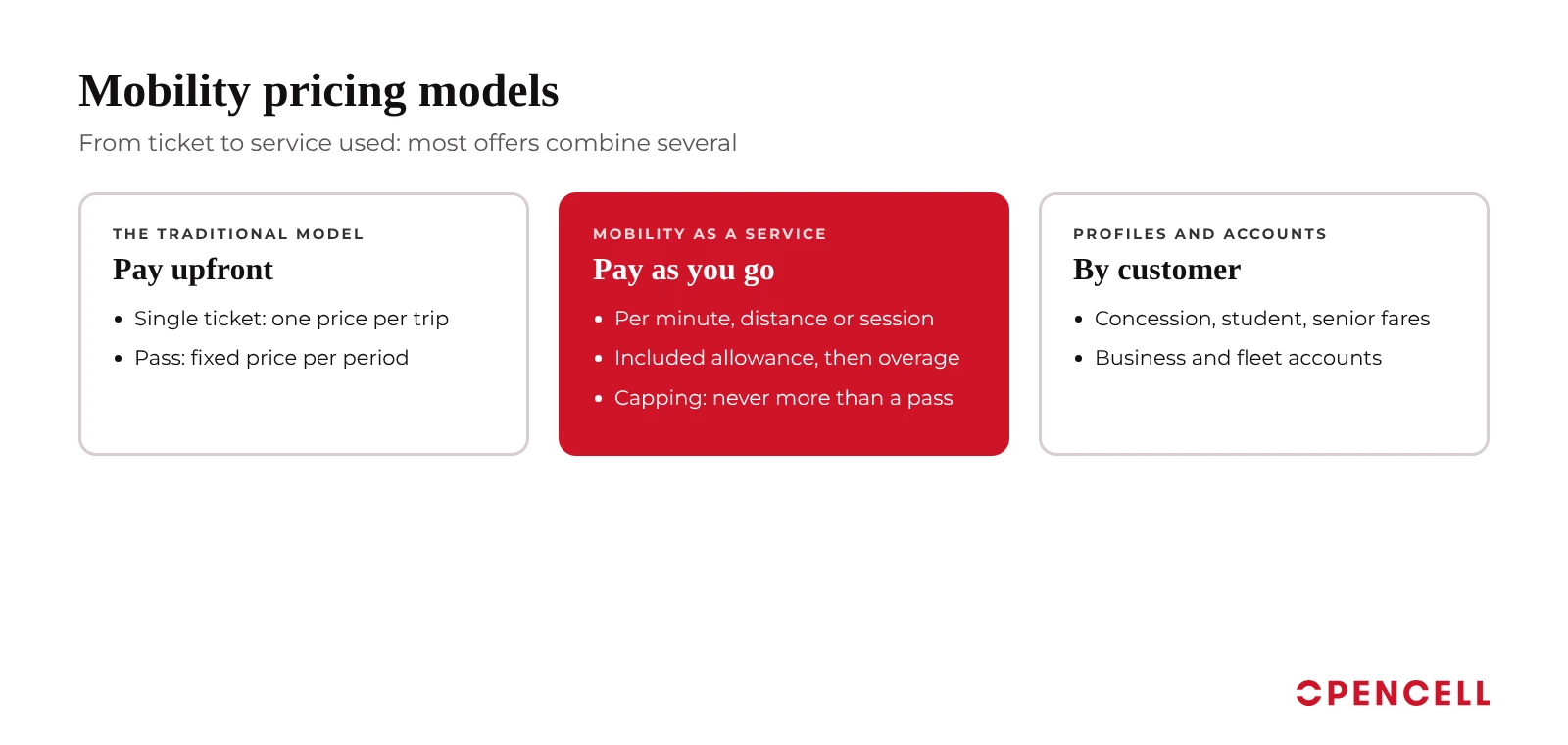
Fare capping deserves special attention: travelers pay as they go, but never more than the price of a pass for the day or month. Simple for them, but the system has to recalculate what is owed continuously, trip after trip. Our guides to usage-based billing and pricing models cover these mechanisms.
From tickets to account-based travel
Account-based travel replaces buying a ticket upfront with a single account: travelers identify themselves, use services, and receive a bill at the end of the period based on actual usage, with caps and discounts applied.
This is the shift from prepayment to post-payment. Several cities have done it, combining public transport, bike sharing, car sharing and parking in one account billed monthly on actual usage.
It changes billing deeply:
- Every tap becomes an event to collect, check and rate.
- The bill is calculated after the fact, applying the period's rules: caps, bundles, profile-based fares.
- Credit risk appears: you need a card or a direct debit mandate, reminders and sometimes account suspension.
- Customer service changes: disputed trips, refunds, goodwill gestures.
Open payment (tapping a bank card at the validator) follows the same logic: the traveler taps, trips are matched at the end of the day, then the best applicable fare is charged. Billing becomes invisible to the traveler, and very demanding for the system.
MaaS: billing a multimodal offer
MaaS (Mobility as a Service) brings several mobility services into one interface, with one booking and one payment. For billing, that means one customer, several providers and revenue to share between them.
MaaS platforms usually offer two models:
- Pay per trip: each service is billed at its price, sometimes with a combination discount.
- Multimodal subscription: a monthly plan that includes public transport and credits or minutes on other modes.
Either way, the platform must:
- Collect usage from each operator, in different formats.
- Rate each trip according to the customer's offer.
- Bill the customer once, with clear detail by mode.
- Collect payment and manage bad debt.
- Pay each operator its share, under contract rules.
Step 5 is often the hardest. When a multimodal plan includes transit, bikes and car sharing, "who gets how much?" has no obvious answer. Rules can be based on actual usage, a fixed key, or a mix. Our guide to revenue sharing billing covers these models.
Readability is the other MaaS challenge. A bill mixing bike minutes, bus trips and car-sharing hours must stay clear: a total per mode, trip details one click away, caps and discounts clearly shown. Confusing bills generate disputes, and every dispute costs more than the trip.
MaaS also opens the door to employer offers: a company funds part of its employees' travel, with one invoice, detail per employee and usage rules (allowed modes, caps, working days). The billing platform then handles two payers for one traveler: the employer for its share, the employee for the rest.
Billing by mode of transport
Each mode has its own billing specifics, but all combine a pass or access right, usage to rate and rules tied to the customer's profile.
- Public transport. Passes, concession fares, single tickets, capping in post-payment. High tap volumes and fare rules set by the transit authority.
- Bike and scooter sharing. Annual or monthly pass with included minutes, per-minute overage, unlock fees, penalties (out-of-zone drop, bike not returned), deposits.
- Car sharing. Hourly and distance rates, day packages, fuel or charging included, deductibles and damage, business accounts with several drivers.
- Parking. Duration-based pricing, resident permits, reservations, integration with the mobility account or park-and-ride.
- EV charging. Price per kWh, per minute or per session, roaming between networks. See our guide to EV charging billing.
- Fleets and businesses. One invoice per company, sub-accounts per employee, caps and cost centers. Account hierarchies become essential.
Revenue sharing and payouts
In mobility, almost every euro or dollar collected must be split: between the authority and the operator, between the sales platform and the services sold, between roaming networks. Payouts must be calculated at the same pace as billing.
| Set-up | Who collects | Who gets a share |
|---|---|---|
| Public service contract | The operator on behalf of the authority | The authority, per contract |
| MaaS platform | The platform | Each integrated transport operator |
| Bundle | The seller of the bundle | Providers of the included services |
| Roaming (charging, parking) | The customer's service provider | The infrastructure operator used |
For each set-up, decide the base (billed or collected), how bad debt and refunds are handled, payout frequency and statement format. This is much easier when every trip carries the ID of the operator that delivered it from the start.
Challenges to plan for
Mobility billing projects often stumble on five challenges: event volumes, late or incomplete data, fare complexity, bad debt in post-payment and integration with ticketing and operators.
- Volume. Every tap, rental or charging session is an event. The system must process them continuously, not wait for month end.
- Imperfect data. Duplicate, late or incomplete events must be checked before billing, and the system must be able to recalculate.
- Fare complexity. Profiles, caps, bundles, combination discounts: rules change often and must be configured, not coded.
- Bad debt. In post-payment, operators extend credit to travelers. Reminders, suspension and collections are part of the project. See our guide to reducing DSO.
- Integration. Ticketing systems, apps, partner operators, payments, accounting: the billing platform sits in the middle and connects through APIs.
Add e-invoicing for business customers (fleets, employers) and data protection: travel data is personal and sensitive. Keep only what billing, customer service and the law require, choose hosting accordingly (many authorities require European or sovereign hosting), and make the bill readable trip by trip.
Running the project in 6 steps
A mobility billing project succeeds when it starts from the traveler's journey, models offers before choosing a tool, and tests calculations on real trips before launch.
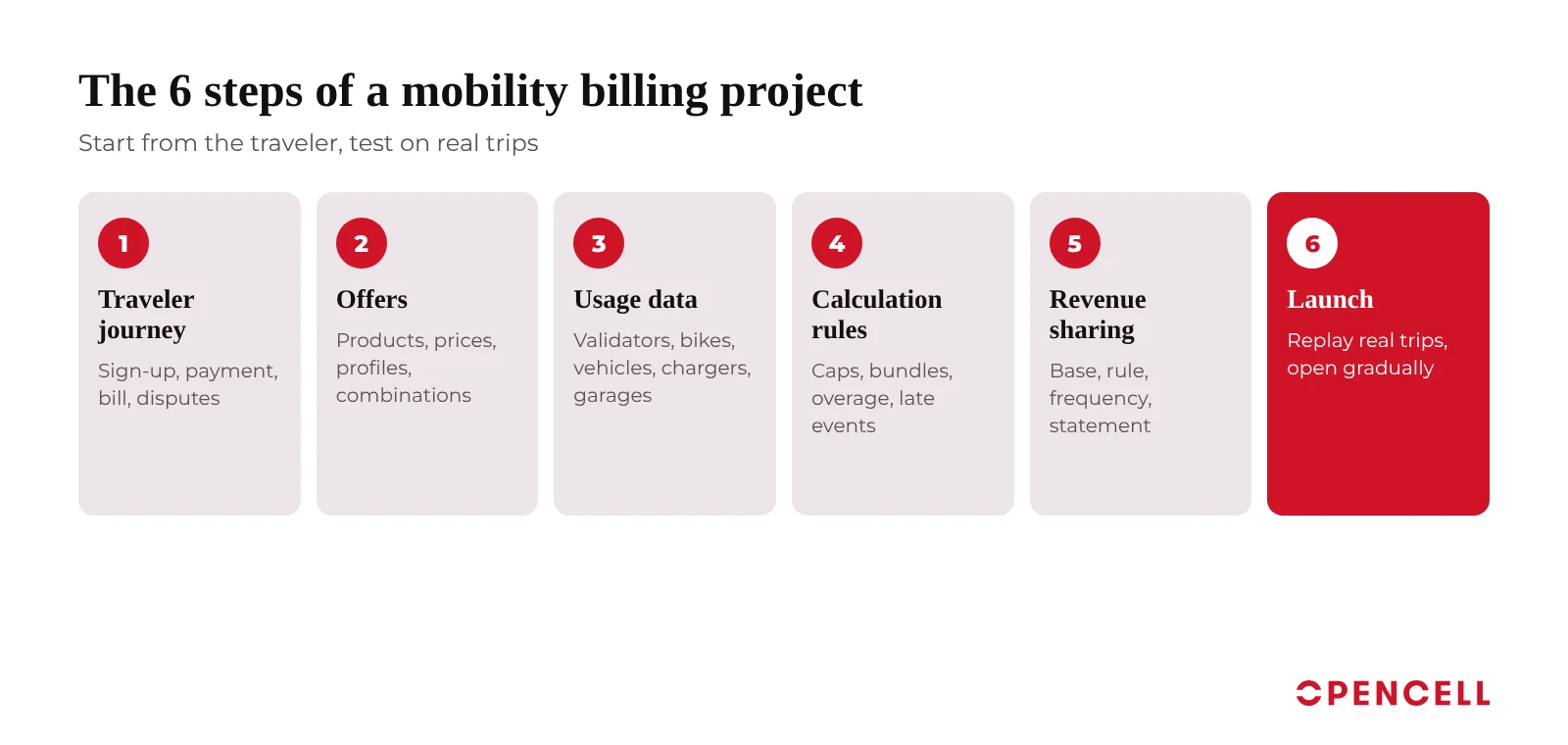
- Start from the traveler journey. Sign-up, payment, what the bill shows, how to dispute a trip.
- Model the offers. Products, pricing models, profiles and combinations: the catalog to configure.
- Map usage data. Which systems produce events (validators, bikes, vehicles, chargers, garages), in what format, with what delay and quality.
- Write the calculation rules. Caps, bundles, overage, combination discounts, late events and disputes.
- Define revenue sharing. For each partner: base, rule, frequency, statement, settlement invoice.
- Test, then launch. Replay months of real trips, compare amounts with expectations, open gradually to groups of travelers.
10 criteria to choose a mobility billing platform
A mobility billing platform must rate usage continuously, combine passes, bundles and caps, handle profiles, bill in post-payment and pay partners, at high volume.
- Usage rating in real time or near real time: minute, distance, trip, kWh.
- Combined models: passes, bundles, overage, capping, with no custom code.
- Profiles and entitlements: concessions, proof, effective dates, retroactivity.
- Post-payment: account-based billing, end-of-period bills, recalculation for late events.
- Multimodal: several operators and services in one account and one bill.
- Revenue sharing: rules per partner, statements, payouts.
- Business accounts: hierarchies, sub-accounts, cost centers, e-invoicing.
- Payments and collections: cards, direct debit, reminders, suspension.
- Volume: millions of events per month without slowdown.
- Openness and deployment: APIs, connectors, sovereign hosting for sensitive data.
How Opencell can help
Opencell bills high-volume subscription and usage-based services, and mobility accounts for 12% of its customers, including Île-de-France Mobilités, Smovengo, TTB, Parkeon, PSA Banque and A-to-Be.
- Real-time usage rating: every trip, rental or session is rated as it arrives.
- Configurable pricing models: passes, bundles, overage, tiers, event-based prices.
- B2B2X customer hierarchies for business accounts, fleets and partners.
- Automated commissions and payouts between stakeholders.
- More than 200 APIs for ticketing, apps, payments and accounting.
- The deployment you choose: sovereign SaaS, cloud or on premises, with go-live in 3 months on average.
Frequently asked questions about mobility billing
What is mobility billing?
It covers every step that turns the use of a transport or mobility service into a collected invoice: pricing, counting trips or durations, passes and discounts, invoicing, payment, collections and payouts to partners.
What is account-based ticketing?
A single account gives access to several mobility services. Travelers do not pay upfront: they are billed at the end of the period on actual usage, with caps and discounts applied.
How is a MaaS offer billed?
The platform collects usage from each operator, rates each trip according to the customer's offer, issues one bill, collects payment, then pays each operator its share under contract rules.
What is fare capping?
A rule guaranteeing that travelers never pay more than a set amount over a period, such as the price of a day pass. The system recalculates what is owed trip after trip.
How do you manage bad debt in post-payment?
Require a valid payment method at sign-up, send automatic reminders, suspend the account beyond a threshold and track receivables as in any subscription business.
How do mobility operators share revenue?
Tag each trip with the operator that delivered it, then apply the contract rules: share of actual usage, a fixed key or a mix, with regular statements and payouts.
Can one platform bill transit, bike sharing and car sharing?
Yes, if it rates usage per event, combines passes, bundles and caps in one account and pays each operator its share. That is what multimodal accounts and MaaS offers require.
In mobility, the bill follows the traveler. The platform has to follow the bill.
Key takeaways:
- mobility is moving from selling tickets to billing for services used,
- offers combine passes, usage, bundles, caps and profile-based fares,
- account-based travel and MaaS require post-payment, recalculation and a single bill,
- almost every amount collected must be shared: payouts are part of billing,
- choose a platform that rates usage continuously and is configured rather than coded.
Go further with Opencell
Opencell is an agile monetization platform that automates quote-to-cash, from quote to cash collection, for subscription and usage-based services. Mobility accounts for 12% of its customers, including Île-de-France Mobilités, Smovengo, TTB, Parkeon, PSA Banque and A-to-Be. Its core is open source, it connects to your ecosystem through more than 200 APIs, deploys as sovereign SaaS, in the cloud or on premises, and goes live in 3 months on average. It manages €14 billion in revenue for around fifty customers.
Launching or evolving a mobility offer?